
Geography Associate Degree at College of Marin: Your 2-Year Path
Explore the Geography Associate's degree at College of Marin, a 2-year in-person program that blends field studies and GIS skills for transfer or careers.

By Ethan Clark
Geography is often described as the subject that bridges the natural and social sciences, and for students at College of Marin, it offers a practical, transfer-ready pathway into a wide range of careers. If you are drawn to maps, data, environmental systems, or global patterns, the Geography Associate's degree, usually 2 years In-person at College of Marin, provides a structured and affordable route to either enter the workforce or continue toward a four-year university. This program is designed for students who want to understand the world around them while building technical skills in GIS, spatial analysis, and field research.
Unlike many associate degrees that are purely vocational, the geography program at College of Marin is built around the California State University (CSU) General Education transfer pattern. That means every course you take not only counts toward your associate degree but also satisfies lower-division requirements for a bachelor's degree in geography or a related field at many universities. This dual purpose makes the program a smart investment for both immediate employment and long-term academic growth. For a detailed overview of how two-year degrees function in the broader educational landscape, you might find our guide on associate degree structures helpful, even though it focuses on psychology, as many transfer principles apply.
Why Choose an In-Person Geography Degree at College of Marin?
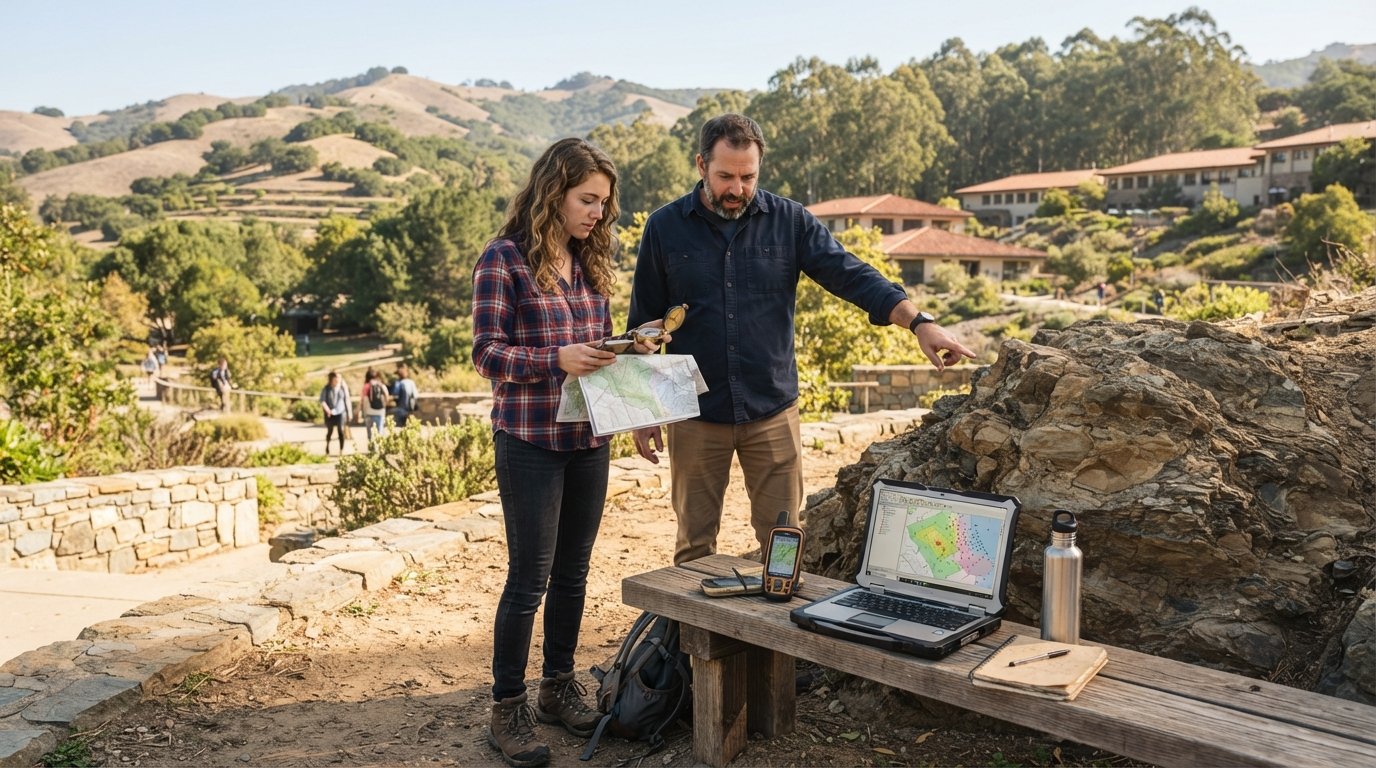
In an era when online programs are increasingly common, the decision to study in person is deliberate. For geography, the in-person experience at College of Marin is not just a matter of preference; it is an academic advantage. The program leverages the college's unique location in Marin County, which sits between the Pacific Ocean and the San Francisco Bay, to provide a natural laboratory for environmental geography. Students engage in fieldwork that is impossible to replicate through a screen, from soil sampling and vegetation mapping to coastal erosion studies.
Furthermore, the in-person format allows for close mentorship. Geography faculty at community colleges are often former professionals from fields like urban planning, cartography, or environmental consulting. Their office hours and classroom interactions become a gateway to internships and local networking opportunities. While online degrees offer flexibility, they rarely provide the same level of hands-on equipment access, such as GPS receivers, drones, and dedicated GIS computer labs. For a student who learns by doing, the College of Marin campus is an ideal environment.
Another critical factor is cost. Community college tuition is a fraction of what you would pay at a university, and College of Marin participates in the California College Promise Grant, which waives enrollment fees for many eligible California residents. By completing your first two years here, you can save thousands of dollars while earning the exact same lower-division credits as a university freshman. If you are concerned about the total cost of education, many students use resources like CollegeDegrees.School to research financial aid and scholarship options before transferring.
Inside the Curriculum: What You Will Learn
The Geography Associate's degree at College of Marin is not a static collection of map quizzes. The curriculum is carefully sequenced to build both conceptual knowledge and practical skills. Core courses typically include Physical Geography, which covers climate, landforms, and ecosystems, and Cultural Geography, which examines human populations, migration, and land use. These two foundational courses are complemented by a methods sequence that introduces students to geographic information systems (GIS), remote sensing, and cartography.
In the GIS courses, you will learn to use industry-standard software like ArcGIS Pro and QGIS. You will produce digital maps, analyze spatial data, and create visualizations that communicate complex patterns. This technical proficiency is the single most marketable skill you will gain from the program. Employers in fields as diverse as public health, real estate, and disaster response struggle to find candidates who can both interpret geographic concepts and manipulate spatial datasets. Your coursework will include projects that mimic real-world scenarios, such as mapping fire risk zones in the wildland-urban interface or analyzing demographic shifts in the Bay Area.
The program also emphasizes critical thinking through regional electives. Courses like Geography of California or Geography of the Global Economy allow you to apply your skills to specific contexts. You might study the agricultural landscapes of the Central Valley, the transportation networks of the Pacific Rim, or the geopolitical tensions over water resources. These electives not only fulfill transfer requirements but also help you identify which subfield of geography you might want to pursue in a bachelor's program.
Fieldwork and Applied Learning
One of the most distinctive aspects of the College of Marin program is its emphasis on fieldwork. In your physical geography lab sessions, you will not just read about stream discharge; you will visit local creeks and measure it. In your cultural geography class, you may conduct pedestrian surveys in nearby towns to analyze land use patterns. These exercises teach you observation, data collection, and report writing, skills that translate directly to professional practice.
For example, a typical semester might include a project to map the invasive species in a local open space preserve. Using GPS units to record locations, you would then bring your data back to the GIS lab to produce a distribution map and a management recommendation. This kind of project-based learning creates a portfolio piece that you can show to future employers or transfer admissions committees. It also instills confidence in your ability to handle messy, real-world problems that do not have a single textbook answer.
Career and Transfer Pathways After Graduation
Graduates of the Geography Associate's degree at College of Marin leave with options. The most common path is to transfer to a four-year institution to complete a bachelor's degree in geography, environmental studies, or urban planning. The program's alignment with CSU General Education means that you can enter as a junior, having already satisfied most general education requirements. Many students go on to California State University campuses such as San Francisco State, East Bay, or Chico, all of which have strong geography departments. The transfer process is supported by the college's articulation agreements and dedicated counseling staff.
But transfer is not the only outcome. The associate degree itself qualifies you for several entry-level positions. Job titles you might pursue include GIS technician, mapping assistant, environmental field technician, or urban planning aide. These roles are often found in local government agencies, utility companies, environmental consulting firms, or engineering firms. The Bureau of Labor Statistics projects that employment for cartographers and photogrammetrists will grow about as fast as the average for all occupations, with geographic information systems (GIS) specialists remaining in steady demand.
For those who are still deciding on a long-term career, the associate degree serves as a low-risk exploration. You can complete internships and part-time work in a geography-related field while in school, giving you practical exposure without the pressure of a four-year commitment. If you discover that you enjoy the analytical side of geography, you might specialize in GIS. If you are more drawn to environmental issues, you could pivot toward a degree in environmental science or sustainability.
Admissions, Cost, and Program Requirements
Enrolling at College of Marin is a straightforward process for most students. California residents who are 18 or older, or who have a high school diploma or equivalent, are generally eligible. You will need to complete an online application, submit transcripts if you have prior college coursework, and take a placement test if required for English or math. The college offers both fall and spring admission, and the geography program has no additional application requirements beyond general enrollment.
The total cost for the two-year program is remarkably low. In-state tuition is calculated per unit, and for a full-time load of 12 units, the cost is approximately $46 per unit, which totals around $552 per semester. However, the California College Promise Grant can waive these fees entirely for students who meet income requirements. Beyond tuition, you should budget for textbooks, a personal laptop (though the GIS lab has desktop workstations), and transportation to and from campus. Financial aid, including the Pell Grant and Cal Grant, can also be applied to these expenses, and the college's financial aid office offers workshops to help you apply.
To earn the associate degree, you must complete a minimum of 60 semester units, including general education requirements and at least 18 units in the geography major. A grade of C or better is required in all major coursework. It is important to work with an academic counselor each semester to ensure you are on track for both degree and transfer requirements. Below is a typical sequence for a full-time student:
- First Semester: Physical Geography with Lab (4 units), Cultural Geography (3 units), English Composition (3 units), Math course (3 units).
- Second Semester: Introduction to GIS (4 units), Geography of California (3 units), Oral Communication (3 units), Arts/Humanities elective (3 units).
- Third Semester: GIS Applications (4 units), Physical Geology (4 units) or other science, Social Science elective (3 units), Transferable elective (3 units).
- Fourth Semester: Remote Sensing (3 units), Global Geography (3 units), Electives to reach 60 units, and finalize transfer applications.
This sequence is flexible, and many students take fewer units per semester while working part-time. The key is to maintain consistent progress, as some GIS courses have prerequisites that require sequential enrollment.
Is This Degree Right for You?
The Geography Associate's degree at College of Marin is an excellent fit for several types of students. If you are a recent high school graduate who loves the outdoors and has an aptitude for technology, this program gives you a clear path to a professional career. If you are a working adult seeking a career change, the part-time options and evening classes (when available) allow you to upskill without abandoning your current job. And if you are a veteran or a parent returning to school, the structured yet flexible nature of the program can accommodate your other responsibilities.
However, it is worth noting that geography is not a field for everyone. If you dislike analyzing data or writing reports, you may find the technical courses challenging. If you prefer abstract reasoning over hands-on fieldwork, other social science programs might be a better match. Before you commit, it is wise to attend a class or speak with the department chair. You can also explore the college's website for a full list of course descriptions and learning outcomes. Remember, an associate degree is a stepping stone, and the best program is one that aligns with your eventual goals.
Making Your Decision
Choosing where to study is a personal decision, and the Geography Associate's degree, usually 2 years In-person at College of Marin, offers a rare combination of affordability, rigorous instruction, and beautiful surroundings. The campus itself is nestled in the hills of Kentfield, with views of Mount Tamalpais, and the proximity to diverse ecosystems provides an unrivaled learning environment. You will not just read about geography; you will experience it.
As you evaluate your options, consider visiting the College of Marin campus and sitting in on a geography lecture. Talk to current students about their projects and their plans. Ask the faculty about transfer outcomes and internship placements. The more you engage with the program firsthand, the more confident you will be in your decision. Whether you aim to become a GIS analyst, an urban planner, or a geography teacher, this two-year investment is a solid foundation.
If you are ready to take the next step, begin by checking the College of Marin admissions page for application deadlines. Then, schedule an appointment with a counselor who specializes in geography or STEM pathways. They can help you create a personalized educational plan that saves you time and money. With careful planning and dedication, you can complete this degree in two years and open the door to a future that is both geographically and professionally expansive.