
LPN Training Certificate at CAAN Academy of Nursing
The LPN certificate at CAAN Academy of Nursing is a 1 to 2 year in-person program that prepares you for NCLEX-PN licensure and direct patient care jobs.

By Lucas Lucas
Choosing a nursing program is one of the most consequential decisions a future healthcare professional can make. If you are searching for a fast, hands-on route into patient care, the Licensed Practical/Vocational Nurse Training Certificate, 1 year to less than 2 years In-person at CAAN Academy of Nursing deserves a close look. This program is built for students who want to enter the workforce quickly, learn clinical skills in a real classroom and lab environment, and sit for the NCLEX-PN exam with confidence. Unlike four-year degrees, this certificate keeps you focused on the essentials: direct patient care, medication administration, and the communication skills that make practical nurses indispensable in hospitals, clinics, and long-term care facilities.
The Bureau of Labor Statistics projects steady demand for licensed practical and licensed vocational nurses through the next decade, driven by an aging population and the ongoing need for bedside care. That demand is exactly why so many career changers and recent high school graduates turn to certificate programs rather than longer degree paths. CAAN Academy of Nursing structures its LPN program to deliver the academic foundation and supervised clinical hours you need to become licensed in a compressed timeframe, so you can start earning sooner and build experience that can later stack into an RN bridge program. If you want to see how this certificate fits into a broader nursing career map, a helpful starting point is this guide on becoming a nurse in Alaska, which outlines the steps from entry-level training to advanced credentials.
What the Licensed Practical/Vocational Nurse Training Certificate Covers
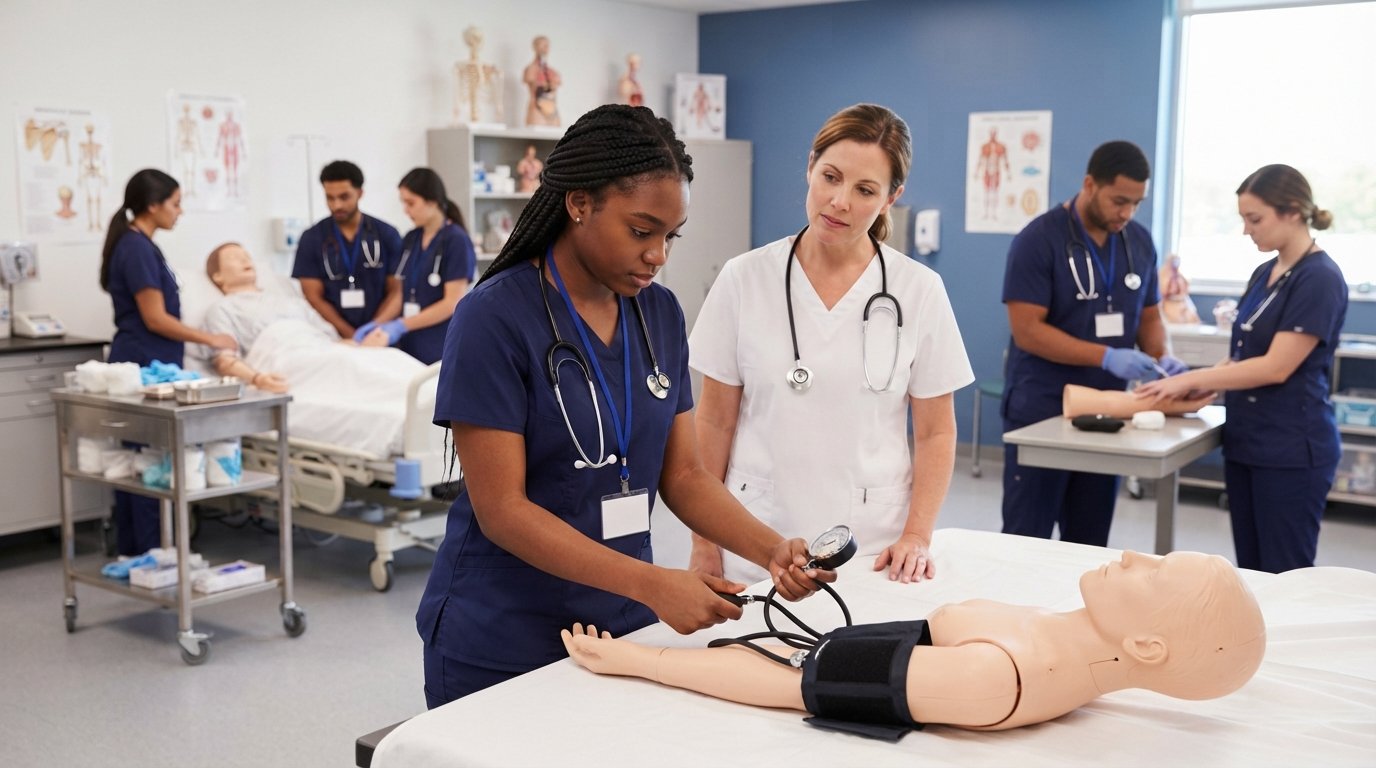
At its core, the Licensed Practical/Vocational Nurse Training Certificate, 1 year to less than 2 years In-person at CAAN Academy of Nursing is a competency-based program. That means every course is tied to a skill you will actually perform on the job. You will study anatomy and physiology, nutrition, pharmacology, and nursing fundamentals, but you will also spend significant time in skills labs practicing injections, wound care, catheter insertion, and vital sign assessment. The in-person format is a major advantage here because nursing is a tactile profession. You cannot learn sterile technique by watching a video alone. You need an instructor beside you, correcting your hand placement and reinforcing safety protocols in real time.
The curriculum typically blends classroom instruction with supervised clinical rotations in partner healthcare facilities. During those rotations, you work under the guidance of registered nurses and experienced LPNs, gradually taking on more responsibility as your confidence grows. By the end of the program, you should be able to collect patient data, administer medications within your scope of practice, assist with daily living activities, and communicate observations to the care team. These are the exact competencies that employers screen for when hiring practical nurses, and they are the same skills tested on the NCLEX-PN licensing exam.
Because the program is offered in person, you also benefit from face-to-face interaction with faculty who have worked in the field. Many instructors at CAAN Academy of Nursing bring years of bedside experience, which means the case studies and scenarios they share come from real patient rooms, not just textbooks. That kind of mentorship is hard to replicate in a fully online format, and it is one reason students who thrive in structured, hands-on environments often choose this path over self-paced alternatives. For adult learners who need to compare this against distance options, resources like DegreesOnline.Education can help clarify how online and campus-based programs differ in cost, schedule, and clinical requirements.
Admission Requirements and the In-Person Advantage
Admission to the Licensed Practical/Vocational Nurse Training Certificate, 1 year to less than 2 years In-person at CAAN Academy of Nursing generally requires a high school diploma or equivalent, a satisfactory background check, and completion of prerequisite coursework or entrance exams depending on the cohort. Some students enter directly from high school, while others arrive after years in retail, hospitality, or administrative roles. The common thread is a willingness to commit to a demanding schedule. Because the program is in person, you should plan for daytime classes, lab sessions, and clinical shifts that may start early in the morning or extend into the evening.
The in-person advantage extends beyond skill practice. When you attend class on campus, you build a professional network. Your classmates become study partners, and your instructors become references. You also develop the habit of showing up on time, communicating clearly with a team, and handling the physical demands of a clinical day, all of which are part of the hidden curriculum of nursing. Employers notice graduates who have already practiced these routines in a structured setting.
Before you apply, it helps to organize the process into clear steps so nothing slips through the cracks. Here is a practical sequence that most applicants follow:
- Confirm you meet the basic education and health requirements, including immunizations and a criminal background check.
- Submit your application and official transcripts to CAAN Academy of Nursing before the cohort deadline.
- Complete any required entrance assessment or interview with the admissions team.
- Review the clinical schedule and arrange transportation and childcare well in advance.
- Finalize financial aid, payment plans, or employer tuition assistance before classes begin.
Once you are enrolled, the program moves quickly. You will be in a cohort of peers who progress through the same courses and clinical rotations together, which creates a strong support system. If you fall behind in one area, your instructors and classmates are physically present to help you catch up. That level of accountability is one of the strongest arguments for choosing an in-person certificate over a purely remote option, especially for students who have been out of school for several years.
Career Outcomes and Licensure After Graduation
Graduating from the Licensed Practical/Vocational Nurse Training Certificate, 1 year to less than 2 years In-person at CAAN Academy of Nursing is a milestone, but it is not the final step. To work as an LPN or LVN, you must pass the NCLEX-PN and meet your state board of nursing requirements. Most graduates begin their careers in settings such as skilled nursing facilities, assisted living communities, outpatient clinics, physician offices, and home health agencies. Some move into hospital units after gaining experience, particularly in rehabilitation, behavioral health, or long-term care.
Typical entry-level responsibilities include monitoring patients, changing dressings, administering oral and injectable medications, collecting specimens, and documenting care in electronic health records. The work is physically active and emotionally rewarding, and it provides a clear view of whether you want to stay at the practical nurse level or continue your education. Many LPNs eventually enroll in LPN-to-RN bridge programs, which allow them to apply their certificate credits toward an associate degree in nursing. That pathway can lead to higher pay, broader scope of practice, and more leadership opportunities.
Salary varies by state, facility type, and shift differentials, but practical nursing consistently offers a stable income with benefits and overtime potential. Shift work is common, and many nurses appreciate the flexibility of three-day workweeks in hospital settings or the predictability of weekday hours in clinics. If you are comparing this certificate to other healthcare credentials, consider the total time to licensure, the cost of tuition, and whether the program includes enough clinical hours to make you competitive in the job market. CAAN Academy of Nursing emphasizes hands-on preparation, which helps graduates enter the workforce ready to contribute from their first shift.
Paying for Your Nursing Certificate
Cost is often the deciding factor for students considering a Licensed Practical/Vocational Nurse Training Certificate, 1 year to less than 2 years In-person at CAAN Academy of Nursing. Because the program is shorter than a degree, total tuition is generally lower, but you still need a plan for books, uniforms, stethoscopes, background checks, and exam fees. The good news is that certificate students have access to several funding sources that do not always require repayment.
Start by completing the Free Application for Federal Student Aid (FAFSA). Depending on the school's eligibility and your financial situation, you may qualify for Pell Grants, federal student loans, or work-study programs. Many employers in healthcare also offer tuition reimbursement or tuition assistance for employees who pursue nursing credentials, so it is worth asking your current employer before you assume you must pay everything out of pocket. Scholarships from professional nursing associations, community organizations, and workforce development agencies can further reduce your balance.
It also helps to think about the return on investment. A practical nursing certificate can be completed in roughly a year, which means you enter the job market and start earning sooner than you would with a two-year or four-year degree. That shorter runway often makes the total cost more manageable, even if you borrow a small amount. Before enrolling, ask the admissions office for a clear breakdown of tuition, fees, and estimated living expenses, and confirm which types of aid the program accepts. A written budget keeps surprises to a minimum and helps you focus on coursework instead of financial stress.
Why Choose CAAN Academy of Nursing for Your LPN Training
CAAN Academy of Nursing offers a focused, in-person learning environment that suits students who want structure, accountability, and direct access to instructors. The Licensed Practical/Vocational Nurse Training Certificate, 1 year to less than 2 years In-person at CAAN Academy of Nursing is designed to move efficiently from foundational science to clinical practice, with each course building on the last. Small cohort sizes and lab-based instruction mean you get more hands-on repetitions than you might in a large lecture hall, and clinical placements give you a realistic preview of the daily rhythm of nursing work.
Another advantage is the clarity of the pathway. You know exactly what you are working toward: licensure as an LPN or LVN. There is no ambiguity about electives or major requirements. You complete the certificate, pass the NCLEX-PN, and begin practicing. From there, you can choose to specialize, pursue an RN bridge, or move into supervisory roles over time. The certificate is not a dead end; it is a launching point.
If you are ready to compare this program with other options, take advantage of the matching tools and program directories available through CollegeDegree.Education. You can filter by field, location, and format to see how in-person certificates stack up against online degrees and hybrid programs. The key is to choose the format that matches your learning style, your schedule, and your budget. For students who learn best by doing, the in-person LPN certificate at CAAN Academy of Nursing is a strong, practical choice that can lead to a stable and meaningful healthcare career. DegreesOnline.Education